
The Mehrauli View That Hasn't Changed in 160 Years.
By Ajaz ·
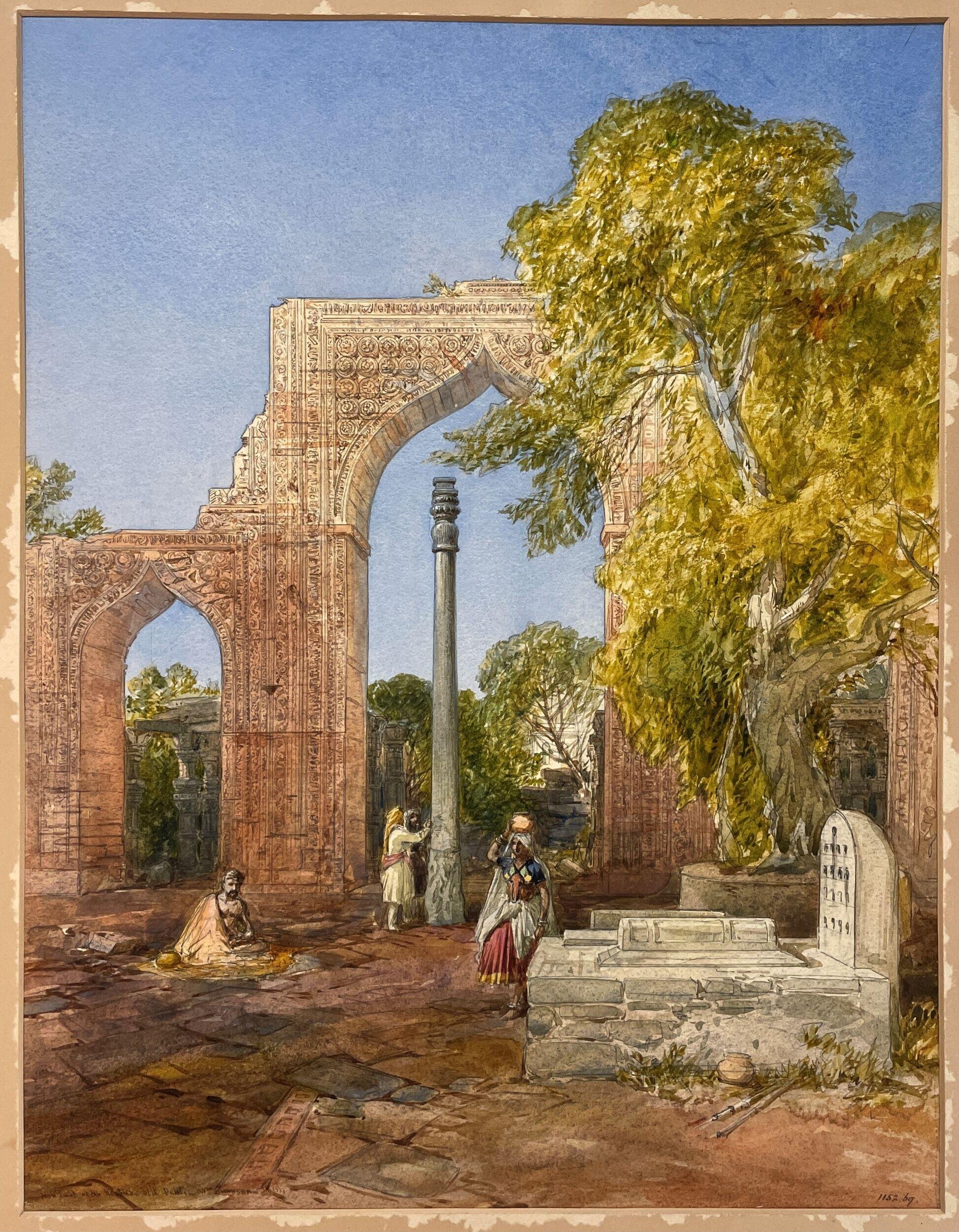
Every time we guide a tour through the Qutb Minar complex, there is one specific hidden angle that completely blows people away.
It is the exact viewpoint where massive, centuries-old sandstone arches align perfectly to frame the ancient Iron Pillar. It turns out, travelers were obsessing over this exact same spot long before Instagram.
Back in 1864, a legendary Scottish artist named William Simpson sat in the dirt of this very courtyard and painted this stunning watercolor. Simpson wasn't just a casual tourist; he was one of the world's very first "war artists" and reportage illustrators. Commissioned to document India's vast heritage after the events of 1857, he traveled from Calcutta to the Himalayas, capturing the subcontinent with a level of detail a camera couldn't match but he wasn't just drawing pretty ruins—he hid secrets right inside the canvas through his unique style:
The Ultimate Mashup: Simpson was a master of the "Picturesque" art movement. He intentionally used a "frame-within-a-frame" technique, lining up a 4th-century Hindu pillar inside a 12th-century Islamic archway to show how Delhi’s layers of history seamlessly puzzle together.
The Master of Textures: Look closely at how the weathered sandstone looks so real. On-site, Simpson only made quick pencil sketches. Back in his London studio, he layered translucent watercolor washes over those lines, letting the raw sketches peek through to mimic the porous texture of Mehrauli's ancient stone. He even used opaque white paint splashes (gouache) to make the light reflecting off the foreground tomb pop.
An Illegal Tradition: Zoom into the base of the pillar. He caught locals wrapping their arms backward around the iron for good luck—a legendary tradition that is now completely banned to protect the monument.
Empires Fall, Life Moves On: Simpson rarely painted empty buildings. By adding a holy man meditating and a woman balancing a water vessel beneath these towering arches, he proved that while massive empires crumble into dust, the quiet, everyday rhythm of Delhi never stops.
The wildest part? You can still walk out into the courtyard and stand inside this exact artistic frame today.
If you want to experience this for yourself, take one of our Qutub Minar tours with us, where we highlight similar hidden stories of the Qutub Minar and Mehrauli! Head over to projectmehrauli.com to book your experience, and follow our journey on Instagram at @project.mehrauli for more forgotten history.