
The Tower with a Forgotten Crown: A 1820 Blueprint of the Qutb Minar.
By Ajaz. ·
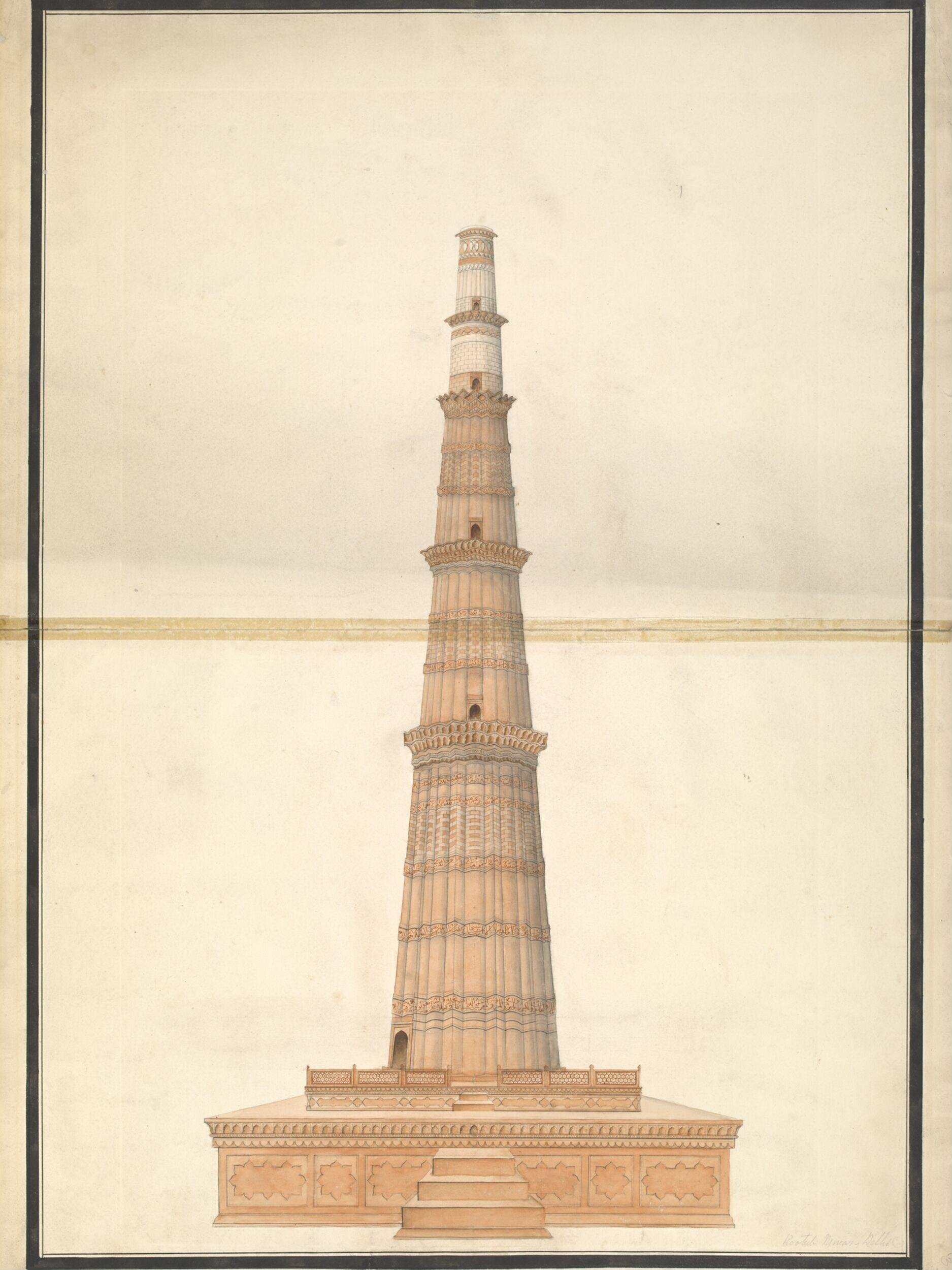
This artwork is an original 19th-century Indian Company School architectural drawing of the Qutb Minar, created circa 1820 by an unknown Indian artist in Delhi.
This piece forms part of historical collections documenting crucial Islamic and Mughal architecture. It is structurally identical to the formal collections held by institutions like the Victoria and Albert Museum.
What it Portrays:
The painting offers a highly precise, elevation-style perspective of the victory tower. It details the monumental scale of the minaret right from its stone base. Interestingly, looking closely at the topmost tier reveals a crucial piece of historical storytelling: the structure is topped with Robert Smith's controversial Gothic-style cupola.
After an earthquake damaged the minaret in 1803, British Major Robert Smith repaired it and installed a new cupola atop the fifth story in 1828. The cupola looked so jarringly out of place with the rest of the Indo-Islamic architecture that it was taken down in 1848 by order of Lord Hardinge and placed on the ground nearby, where it still sits today as "Smith's Folly." This drawing captures that exact, short-lived window of time where the tower wore its British-Gothic crown.
The Painting Style: Company School.
This artwork is a prime example of the Company Style (Kampani Kalam), a hybrid art form that flourished in India during the 18th and 19th centuries.
The Blend: It combined traditional Indian miniature precision with European academic realism, depth, and linear perspective.
The Purpose: British East India Company officials hired local Indian painters to map, catalog, and document the landscape, local trades, and ancient monuments of the subcontinent.
The Aesthetics: Rather than a romanticized landscape with dramatic clouds and people, this style prioritizes clean lines, muted watercolor washes, and meticulous structural accuracy. The focus is entirely on the geometry and fluting of the sandstone.
To explore more historical secrets of this iconic neighborhood, check out tours of Mehrauli and experience its layers of living heritage firsthand.