
Echoes of the Archaeological Raj: Plaster Casts and Colonial Power in Mehrauli.
By Ajaz ·
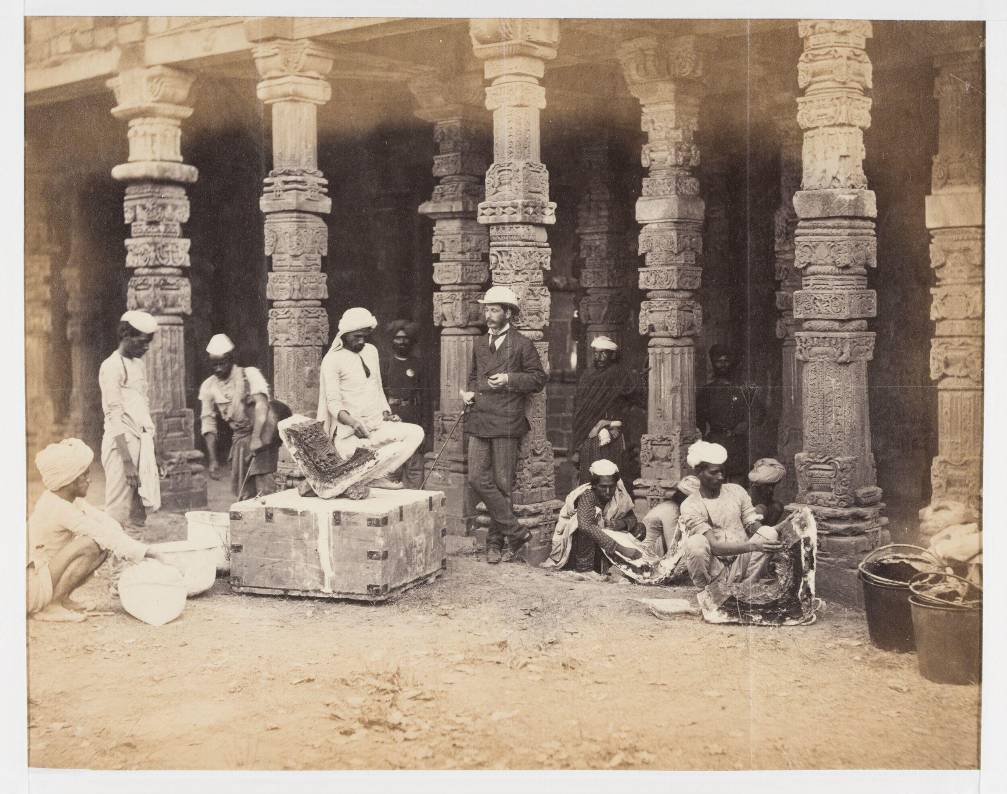
The image captures a striking 19th-century scene of heritage appropriation, showing British officer Major Henry Hardy Cole supervising local Indian craftsmen as they create plaster casts of the ancient pillared cloisters inside the Qutb Minar complex.
This photograph, dating back to around 1881, captures a definitive turning point in the history of Mehrauli. It encapsulates how the British East India Company, and later the British Raj, viewed India's vast architectural treasures—not just as beautiful historic ruins, but as sites of intense colonial study, documentation, and physical transformation.
The Anatomy of the Photograph: Making the Casts
The photograph documents a highly technical and laborious historical process under the colonnade of the Quwwat-ul-Islam Mosque:
• The British Overseer: Standing centrally in a formal suit and a pith helmet, Major Henry Hardy Cole (who served as the Superintendent of the Archaeological Survey of India's Preservation of National Monuments) leans casually against a pillar, cane in hand. His stance embodies the classic colonial posture of administration and scientific authority.
• The Craftsmen: Surrounding him are local Indian laborers and specialized mold-makers. One artisan sits directly on a large wooden crate, meticulously chipping away at or smoothing out a dense, V-shaped plaster mold of a pillar section.
• The Imperial Objective: The buckets, cloths, and mixing materials scattered on the ground were used to create exact plaster replicas of the highly ornate, carved Hindu and Jain temple pillars that had been repurposed to build the mosque cloisters. These massive plaster casts were boxed up and shipped across the ocean to be displayed in London museums like the South Kensington Museum (now the V&A), allowing the British public to study the empire's architectural trophies without ever leaving England.
What the British Did in Mehrauli: A Layered Legacy
Mehrauli, as the oldest continuously inhabited area of Delhi, became a major focal point for British colonial activity. The British footprint in Mehrauli was split between romantic escapism and monumental control:
1. Transforming Ruins into Country Estates (The 1830s–1850s)
Before the formal establishment of the Archaeological Survey of India (ASI), early British administrators treated Mehrauli as a picturesque weekend retreat away from the heat of the main city.
• Metcalfe’s "Dilkusha": Sir Thomas Metcalfe, the British Resident at the Mughal court, famously bought the 16th-century tomb of Jamali Kamali's brother (Mohammad Quli Khan) and completely converted it into a luxurious, air-conditioned country villa named Dilkusha (Heart's Delight).
• Landscaping the Past: Metcalfe surrounded the villa with manicured English gardens, built artificial ruins, turned nearby historic tombs into guest houses, and constructed a lighthouse-like tower known today as Metcalfe’s Folly.
2. The Restorations and Alterations
The British frequently intervened in the physical structure of Mehrauli's monuments, sometimes with controversial results.
• Smith’s Folly (1828): Major Robert Smith of the Bengal Engineers was tasked with repairing the Qutb Minar after an earthquake. He decided to add a completely new, Indo-Saracenic styled chatri (cupola) to the very top of the minaret. It looked so out of place that the Governor-General, Lord Hardinge, ordered it taken down in 1848. It still sits on the lawns today as a reminder of colonial trial-and-error.
3. Classification and Plaster Imperialism (The 1860s–1900s)
Following the rebellion of 1857, the Raj shifted from romanticizing ruins to systematically cataloging them to assert control. Led by figures like Alexander Cunningham and Major Cole (seen in the image), the British began clearing away local settlements that had grown inside the ruins, heavily photographing the sites, and producing the structural plaster copies seen above. While this arguably saved many crumbling structures from collapse, it also stripped the monuments of their active community use, turning living heritage spaces into sterile, policed open-air museums.
The Lasting Impact
When you walk through Mehrauli today, you are looking at history through a lens heavily polished by the British Raj. The open, green lawns, the cordoned-off structures, and the very way the stories of these monuments are told were defined by the men in pith helmets who stood under these arches over a century ago.
Images like this remind us that heritage preservation is rarely neutral—it is a complex, fascinating tug-of-war between the people who built the history, the people who lived in it, and the people who sought to document and control it.