
Framing History: The Tale of Treason and Light in an 19th-Century Masterpiece.
By Ajaz ·
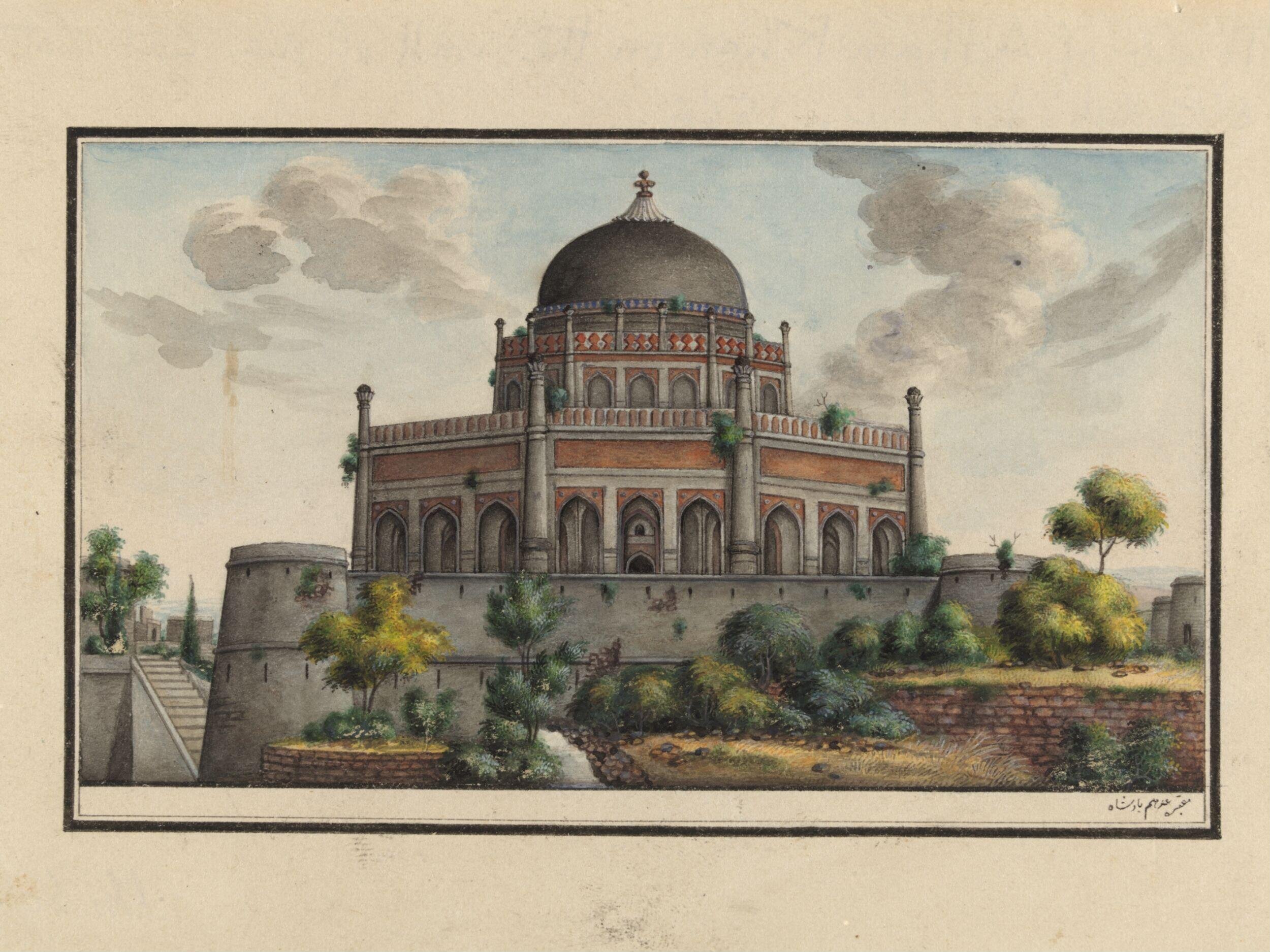
Look closely at the watercolor landscape featured below. This stunning 19th-century Company Style painting, created circa 1840 by a local master artist within the circle of Mazhar Ali Khan, does more than just depict a grand monument. It captures a defining architectural anchor at the historic gateway of Mehrauli: Adham Khan’s Tomb. Historically nickname-famed as Bhool Bhulaiya (the Labyrinth) due to the hidden, maze-like staircases tucked inside its thick limestone walls, this site is one of Mehrauli's most dramatic locales.
A Visual Analysis of the Masterpiece.
This specific painting represents the delicate fusion of traditional Indian craftsmanship with Western perspectives—a signature of local artists working in Delhi under British patronage.
The Architectural Discord: Notice the distinct octagonal structure. While it is a Mughal-era monument commissioned by Emperor Akbar in 1562, it was purposefully built in the older, out-of-date Lodi architectural style. Akbar deliberately chose this layout to visually brand his late foster brother, Adham Khan, as a "traitor" by associating him with the defeated Lodi dynasty.
The Elevated Perch: The artist beautifully emphasizes the high plinth, which is built right over the ancient walls of the 11th-century Rajput fortress, Lal Kot.
The Surrounding Landscape: Long before the bustling Mehrauli Bus Depot took over the foreground, the mausoleum sat in an open expanse of untamed brush, dense trees, and rolling clouds, which are captured here with magnificent, soft watercolor washes.
The Story Behind the Stone: Blood and Betrayal.
The serenity of this painting stands in stark contrast to the violent history that birthed the monument. Adham Khan was Emperor Akbar's general and foster brother. Driven by political jealousy, Adham Khan brashly assassinated Akbar's favorite Prime Minister, Ataga Khan, right inside the imperial court. An enraged Akbar personally ordered Adham Khan to be thrown headfirst off the fort ramparts twice to ensure his execution. Consumed by grief, his mother Maham Anga died forty days later. Akbar then built this grand but unembellished tomb to house both of their remains, combining maternal respect with a harsh public reminder of treason.
The Weird Afterlife of Bhool Bhulaiya.
If you visit the monument today, it is hard to imagine it as anything other than a heritage site. However, during the 1840s—right around the era this painting was executed—the tomb underwent bizarre transformations under
British colonial occupation.
A British Summer Home: A Bengal Civil Service officer named Blake converted the central domed tomb chamber into his personal residence, removing the graves to clear floor space.
A Government Hub: After his death, the British repurposed the structure as a rest house, a local police station, and eventually a post office.
The Heritage Rescue: It wasn't until the turn of the 20th century that Lord Curzon ordered the local authorities to vacate the premises and properly restore Adham Khan’s grave back under the central dome.
Preserving Mehrauli’s Narrative.
Artistic archives like this painting are vital assets for our ongoing documentation at Project Mehrauli. They serve as irreplaceable visual records showing how Delhi's oldest urban neighborhood looked before modern urbanization shifted its boundaries.Today, the monument stands silently opposite the Mehrauli Bus Stand, overlooking local transit instead of rolling country valleys. But through archival art, we can always peer straight back into its storied, dramatic past.
Walk Into History.
Want to explore Mehrauli? Book a Mehrauli Village tour right now to learn more about such heritage sites in Mehrauli. Let our expert storytellers guide you through the hidden alleyways, ancient citadels, and forgotten fortresses that defined Delhi's oldest historic heartland.